
Ruto Charms Tanzania Parliament With Swahili Humor Before Facing Tanga Refinery Heat
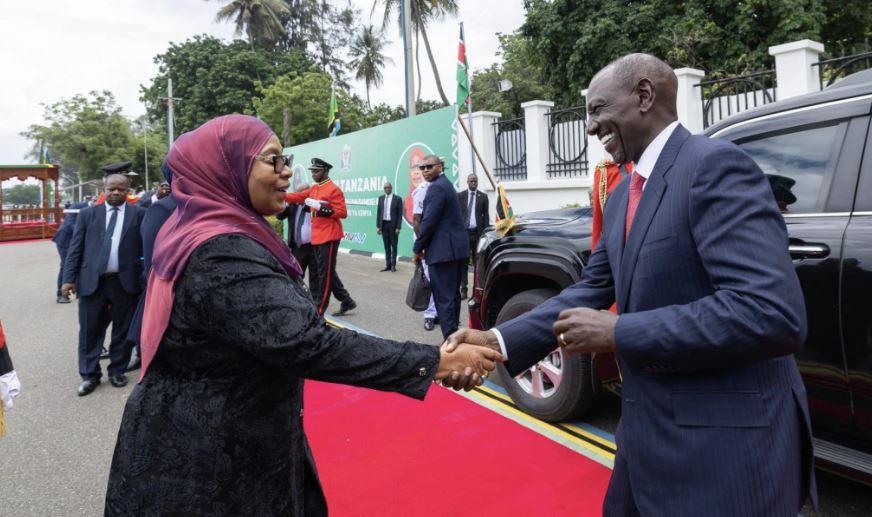
 President William Ruto brought a wave of levity to the Tanzanian Parliament on Tuesday, winning over lawmakers with a witty justification for his choice of language. During his official state visit, the Kenyan leader opted to deliver his keynote address in English, but not before providing a humorous “geopolitical history” of Kiswahili that left the chamber in stitches.
Ruto teased the audience with a playful breakdown of the language’s regional evolution.
“I got to know that Kiswahili was born in Zanzibar, it grew and was rooted in Tanzania. On reaching Kenya, it got sick and proceeded to Uganda. On reaching Uganda, because it experienced severe sickness, it died, and the burial took place in Congo,” Ruto said.
The president maintained the lighthearted tone as he pivoted to his primary remarks, suggesting his linguistic choice was an act of mercy for the language.
“Because of that, let me address you in English so that I don’t do it wrong,” he joked.
During his official visit to bolster bilateral ties between Nairobi and Dodoma, President William Ruto found himself performing a delicate diplomatic dance following a public reprimand from his host, President Samia Suluhu Hassan.
The tension surfaced during the Kenya-Tanzania Business Forum at the Julius Nyerere International Convention Centre in Dar es Salaam on Monday, May 4, 2026, when Suluhu directly addressed Ruto’s recent claims regarding a massive refinery project.
Ruto Faces Tough Questions Over Tanga Refinery
While Suluhu initially spoke on the standard themes of regional cooperation, she pivoted into a sharp, unscripted moment that immediately silenced the room. She publicly challenged Ruto over his recent announcement of a multi-billion-dollar oil refinery slated for Tanga, Tanzania, a project she claimed her administration knew nothing about.
“While we were speaking inside, I pressed Ruto and asked him: you went ahead and announced a refinery in Tanga – why was I not aware? He will explain, himself, why he made that announcement,” she said.
The Tanzanian leader’s critique referred back to comments Ruto made during the Kenya Mining Investment Conference and Expo in Nairobi on April 28. By demanding an explanation in front of the business community, Suluhu underscored the importance of official protocol and bilateral transparency, leaving the Kenyan president to clarify his previous statements on the international stage.
Responding to the tension, President Ruto addressed the controversy head-on, acknowledging that his unilateral announcement had ruffled feathers in Dodoma. He admitted that had he anticipated the diplomatic friction, he might have proposed Mombasa as the alternative site, yet he maintained that the project represents a transformative milestone for East Africa.
“I have been informed that my decision to announce the building of a refinery in Tanga has not sat well with you (Tanzanians). If I knew, I would have announced that refinery to be built in Mombasa,” he said.
He framed the refinery as a catalyst for regional industrialization, highlighting how Kenya, Uganda, Tanzania, and South Sudan could collectively prosper from such an investment.
President Ruto advocated for a strategic shift in how the region handles its natural resources, pushing for Tanga to evolve into a sophisticated hub for both oil refining and mineral processing. He argued that the era of shipping out raw commodities must end if the region hopes to secure its economic sovereignty.
“It is no longer sustainable for us to export raw materials. As a region, we must deliberately avoid exporting value, jobs and opportunities. Instead, we must retain and utilise them locally. That is the future of our development,” Ruto said.
Attempting to bridge the gap with his hosts, Ruto adopted a more conciliatory stance, telling the Tanzanian public they should view the focus on Tanga as a stroke of good fortune.
“Personally, I am helping to bring investment in Tanga. If you were good people, you would have been saying thank you to us Kenyans. Let us work as East Africa.”
President Ruto defended his advocacy for the refinery by framing it as a win for the entire East African Community rather than a win for just one nation. He rejected the idea that economic growth is a zero-sum game, arguing instead that the fates of Kenya and Tanzania are inextricably linked.
“What is good for Tanzania is good for Kenya and vice versa. I am requesting that we are one people. Let us not allow the talks of yesterday to separate us,” he said.
The president called for a fundamental shift in perspective, urging both nations to abandon the mindset of competitors or adversaries. He identified the true enemy as the lack of economic opportunity rather than any neighboring state, advocating for a partnership built on job creation and shared stability.
“We have a common destiny,” he said. “I have explained that Kenyans are not your enemies and vice versa. Our enemies are not each other, but those who are not creating jobs for our people.”
The post Ruto Charms Tanzania Parliament With Swahili Humor Before Facing Tanga Refinery Heat appeared first on Nairobi Wire.